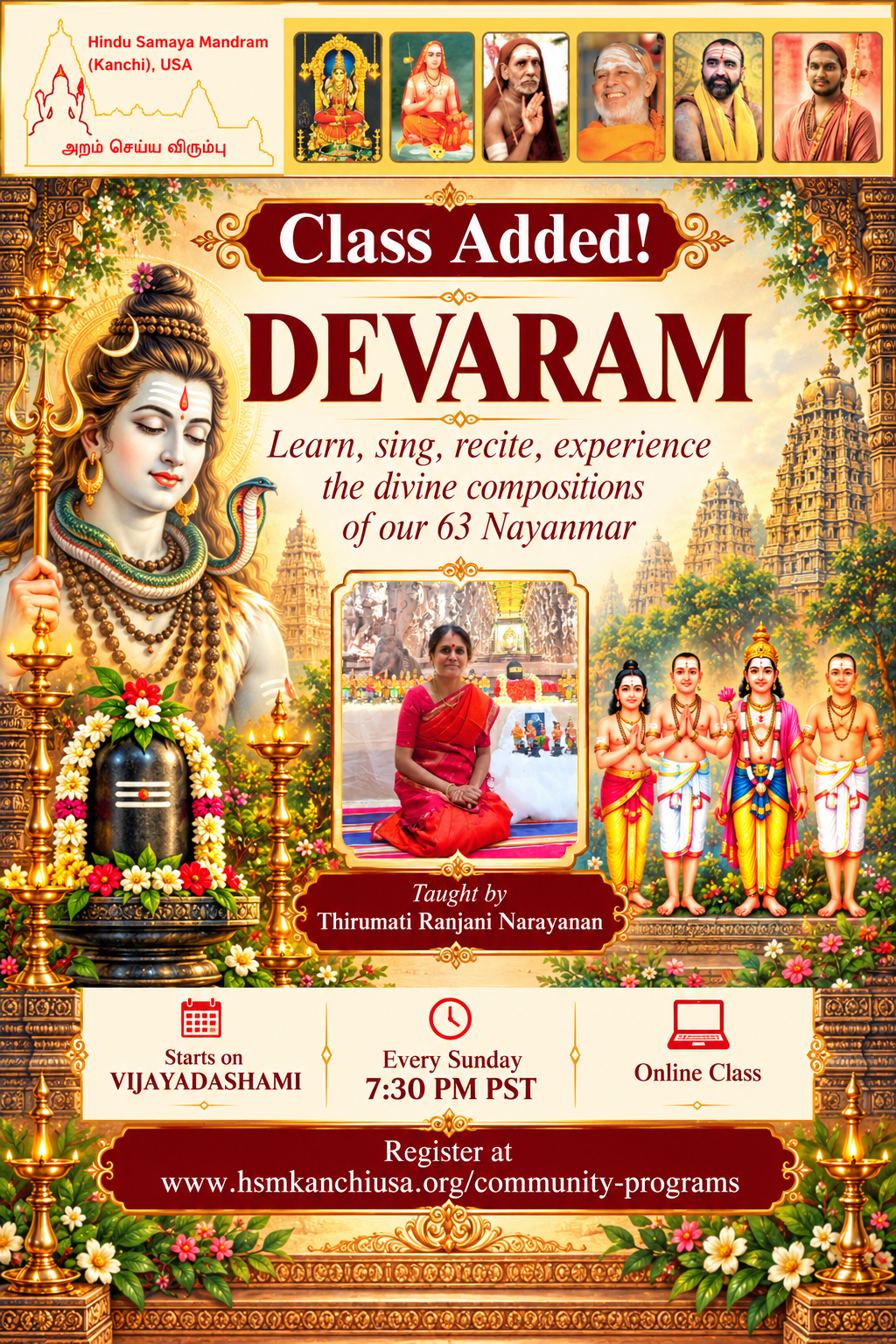
Born in Chidambaram, Thirumati Ranjani feels blessed to be singing Devaram. Her journey began under the guidance of Thiru Gnanaprakasa Othuva Moorthigal and continues under the guidance of Thiru Kumaragurubaran Othuva Moorthigal. For Ranjani, singing Devaram is a way to immerse herself in bliss, feel closer to Sivam, and discover peace and the deeper purpose of life through His divine compositions.
Thirumati Ranjani lives in Seattle, WA with her husband and two sons, who are also trained to sing Devarams since they were little.
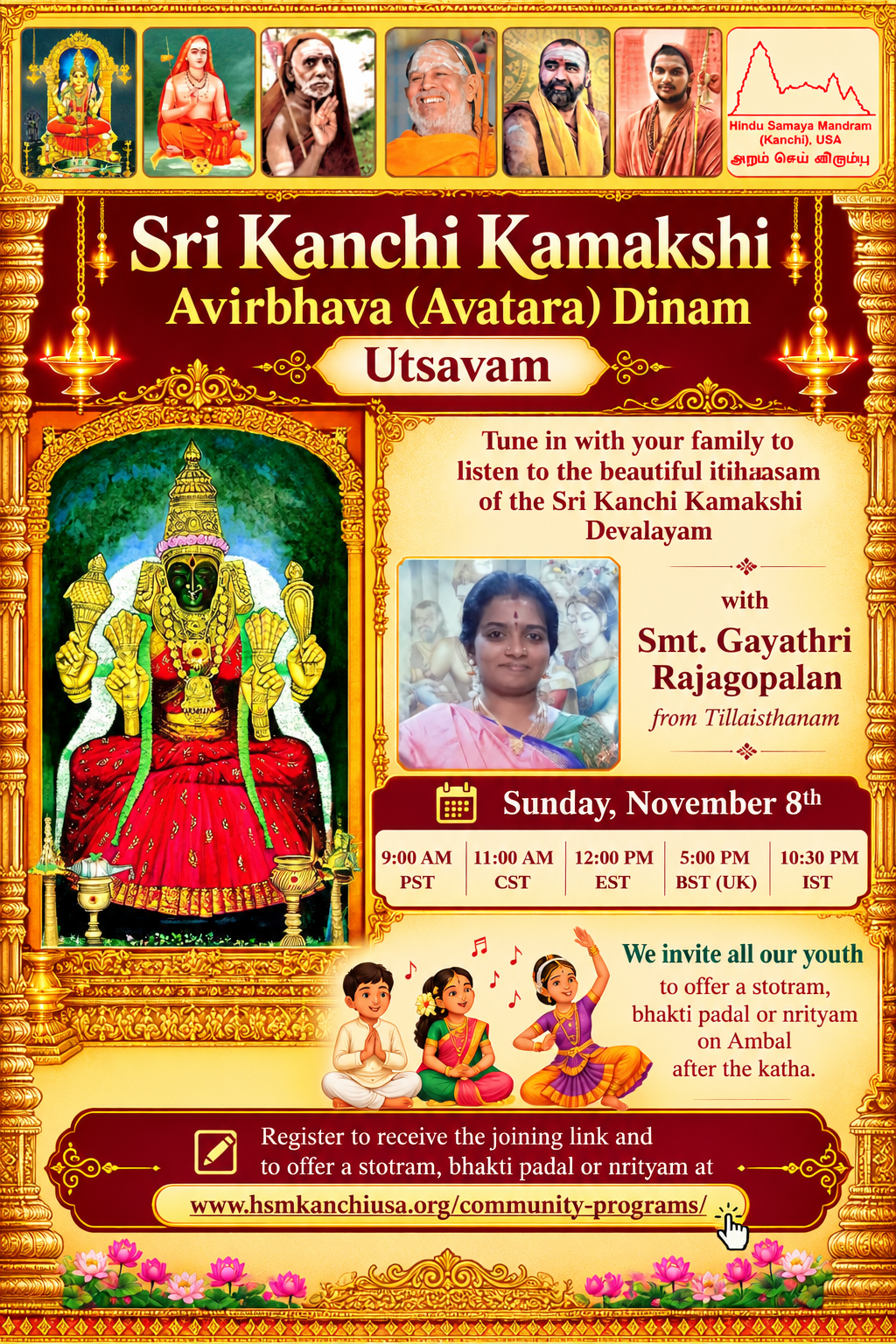
Join us with your children and family to learn about Sri Kanchi Kamakshi Avirbhava Dinam, the day ambal took this avataram in kanchi. After the beautiful telling by Smt. Gayathri Rajagopalan, youth may offer sangitam, stotram or nrityam – sign up at the above link.
About Smt Gayathri Rajagopalan
Smt. Gayathri Rajagopalan is a distinguished practitioner and teacher of traditional Carnatic music, Bhajanai Namasankeerthanam, and Sangeetha Upanyasam, rooted in the rich Praacheena Sampradaya tradition. An Isaikalaimani with formal teacher training, she is proficient in vocal music, veena, and harmonium, and is dedicated to preserving and sharing India’s rich devotional musical heritage.
She specializes in traditional Kalyanam and Namasankeerthanam presentations, including Sri Seetha Kalyanam, Sri Kamakshi Kalyanam, Sri Meenakshi Kalyanam, Sri Parvathi Kalyanam, Sri Gowri Kalyanam, Sri Shankaree Kalyanam, Sri Valli Kalyanam, Sri Radha Kalyanam, and Sri Rukmini Kalyanam, along with several traditional musical compositions associated with these celebrations.
Through her Sangeetha Upanyasams, she expounds the devotional and spiritual significance of sacred Tamil and Sanskrit literature, including Thevaram, Thiruvachakam, Naalaayira Divya Prabandham, and Thiruppugazh. She also conducts music classes for B.A. and M.A. music students and teaches stotras composed by Sri Adi Shankaracharya, Sri Vedanta Desika, Sri Madhwacharya, and other revered acharyas.
Belonging to the esteemed hereditary tradition of Siddhanvazhur Sri Kalyana Sundara Sastrigal, Sri Guruswamy Sastrigal, and Sri Rajagopala Sastrigal, she received her training in Bhajanai and Thevaram from her father, Sri Rajagopala Sastrigal, and in veena from Smt. Rama Kousalya of Thillaisthanam.
Through her music, discourses, and teaching, Smt. Gayathri Rajagopalan continues to uphold the sacred traditions of devotional music and pass this treasured spiritual and cultural legacy on to future generations.
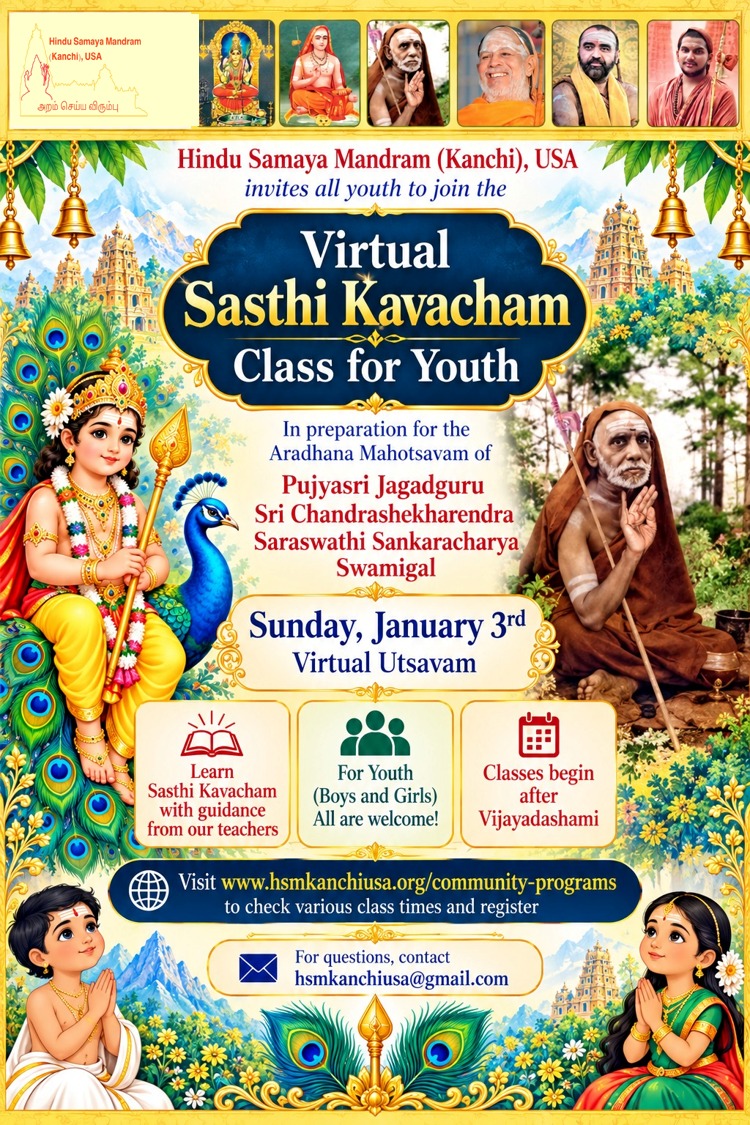
This online class is in preparation for an online samarpanam by our youth on the auspicious occasion of the Aradhana Mahotsavam of Jagadguru Pujyasri Sri Chandrashekharendra Saraswathi Sankaracharya Swamigal, fondly known as the Mahaswami and Mahaperiyava on Sunday Jan 3rd.
We will follow this style of reciting/singing. Memorization is encouraged, but not mandatory.
Hindu Samaya Mandram(Kanchi) USA would like to invite you to join us for the Samashthi Bhikshavandanam on the occasion of the Jayanthi Mahotsavam of Jagadguru Pujyasri Sri Jayendra Saraswathi Sankaracharya Swamigal of Moolamnaya Sarvagnya Sri Kanchi Kamaoti Peetham.
Hindu Samaya Mandram was started in 1972 under the auspices of the Acharya with the goal of spiritual growth for everyone irrespective of their backgrounds. Per the wishes of the current peethadipati, the 70th Acharya Jagadguru Pujyasri Sri Sankara Vijayendra Saraswathi Sankaracharya Swamigal, HSM Kanchi USA and its families will be offering a samasthi/group bhiksha samarpanam.
Essence of Bhikshavandanam, an extract from “Bhikshavandanam” by Sri Kanchi Kamakoti Kainkarya Sabha , and published in the Kanchi NRI Newsletter April 2021
Guru is the one who removes the darkness of ignorance or ajnana. We say, krishnam vande jagatgurum. Krishna Paratma gave upadesham on both Pravrthi Dharma and Nivritti Dharma, on how we should live our lives in this world and on the path of renunciation. Although the gita upadesham was given to Arjuna, it is always meant for everyone. Hence Lord Krishna is called jagatguru.
Acharya Swamigal is likewise a guru for jagat, a universal guru, and a guru here and now, Pratyaksha Guru. Acharya Swamigal is Sankaracharya, an acharya in the Sankaracharya advaita sampradaya. Acharya is defined as one who has thoroughly analysed the sastras , conducts himself according to the acharas laid down in the sastras, teaches the same to others and makes them remain stable in the acharas. There is a slokha which conveys this:
Achinoti hi shastrarthaan aachaare sthaapayathyapi Swayam Acharathe Yascha Tham Aacharyam prachakshate
Sri Maheperiava emphasises, swayam aacharathe – an acharya must practise what he preaches and thereby sustain a tradition. To witness the Chandramouleeswarar trikala puja performed by the Acharya is one of the greatest blessings one can ever have. All the pujas are performed for the welfare of everyone. Several education and charitable institutions are run under the aegis of the mutt. Acharya Swamigal occupies the exalted position of Indra Saraswathi. Indra here means parabrahmavasi embodiment of advaitha parabrahma satyam.
Kamakoti Peetam is also Vaakbhava kutam, essence of vaak sakthi and jnana sakthi – hence Saraswathi. Acharya Swamigal is, importantly, a sanyasi. A Sanyasi is one who has given up everything and therefore subsists on Bhiksa. Although the word Bhiksha is loosely translated as alms, a sanyasi does not seek Bhiksa. On the other hand, it is enjoined upon grihastas to seek out and offer Bhiksa to sanyasis – that is the reason, grihastasrama is called uttama ashrama.
The term used for offering Bhiksa is called samarpanam. Bhiksavandanam is a vandanam, paying obeisance.
Total humility, sraddha and involvement are far more important than the money or the materials contributed. The normal practice, especially when it is a Samashti or group bhiksavandanam, is that the bhiksa covers not only the minimal bhiksha for Periyaval, but, flowers, fruits and other materials for the tri-kala puja and naivedyam supply of full range of groceries, provisions, food grains, vegetables and other cooking materials for prasadam and anna danam and vastram for Niyama Brahmanas. If it is a Tuesday or Friday, sarees for Suvasini pujai are included as well.
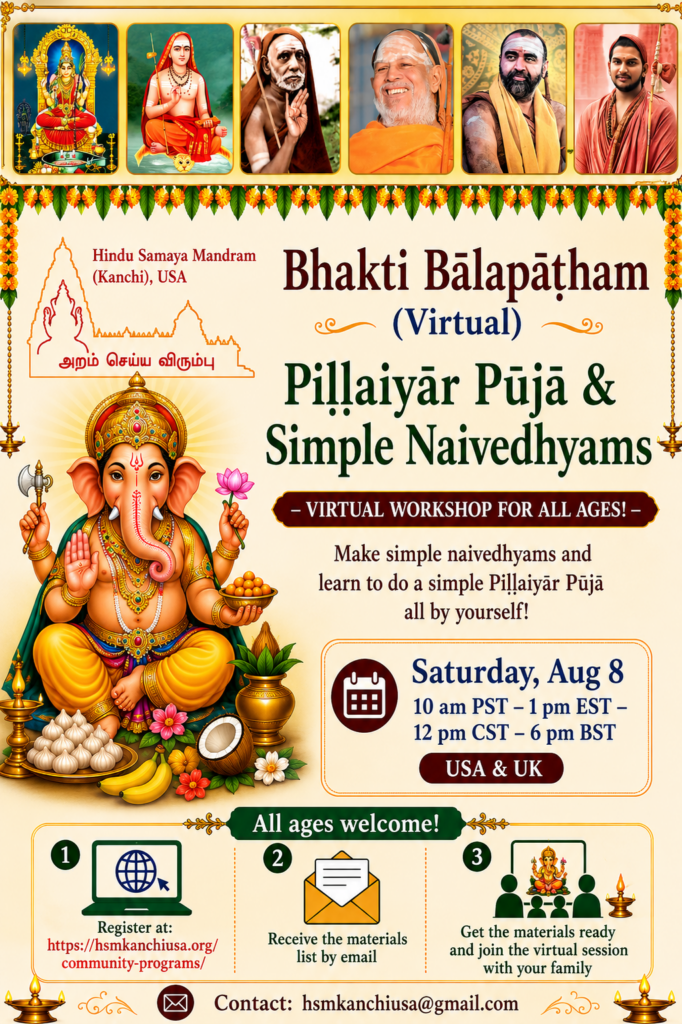
Join us with your kids online to make pillayaar kozhakattais together and give them a hands-on experience to perform their own pillayaar pujai!! Saturday, August 8th – 10am PST/12 pm CST/1pm EST and at 6 pm BST in the UK
With the blessings of Ubhaya Jagadgurus Pujyasri Sri Sankara Vijayendra Saraswathi Shankaracharya Swamigal and Sri Satya Chandrashekharendra Saraswathi Shankaracharya Swamigal
The pavai songs are part of an ancient tradition amongst unmarried young Hindu girls, where they light lamps in the early mornings of Margazhi, and sing songs in praise of Shiva. Manickavasagar composed the twenty songs called Thiruvembavai followed by ten songs called Thirupalliezhuchi. Similarly, Andal thaayaar composed thirty paasurams on Sri Krishna called Thiruppavai. Let us show our love for bhagawan by reciting and singing Thiruvempavai and Thiruppavai.
Click here to access the audio files for Thiruvempavai and Thiruppavai. NOTE: you can recite/sing in any tune, these sample audios are just suggestions.
Eligible Categories: PreK, Elementary, Middle School, High School & College, for ages 21 and under
Dressing up in traditional attire is mandatory for the submission to be eligible – paavadai/daavani/veshti, hair tied in single braid/ponytail and, tilakam for boys and girls
Competition Rounds: Round 1/Prelims and Round 2/Finals
Round 1: Participants may choose any four paasurams or paavais from the above syllabus for video submission
Round 2/Finals: Judges will quiz qualifying finalists on any of the assigned paasurams and pavais listed in the syllabus above.
Round 2 – Qualified finalists from Round 1 will present to judges live virtually
Nov 14th(Time TBD)
Winners announced at a samashthi samarpanam virtual program in December
Date TBD
What Should Participants Focus On? Encourage kids to enjoy the learning and exploration of our puranas while they prepare. Judges will grade based on accuracy of Tamizh pronunciation, traditional attire, reciting/singing and proficiency.
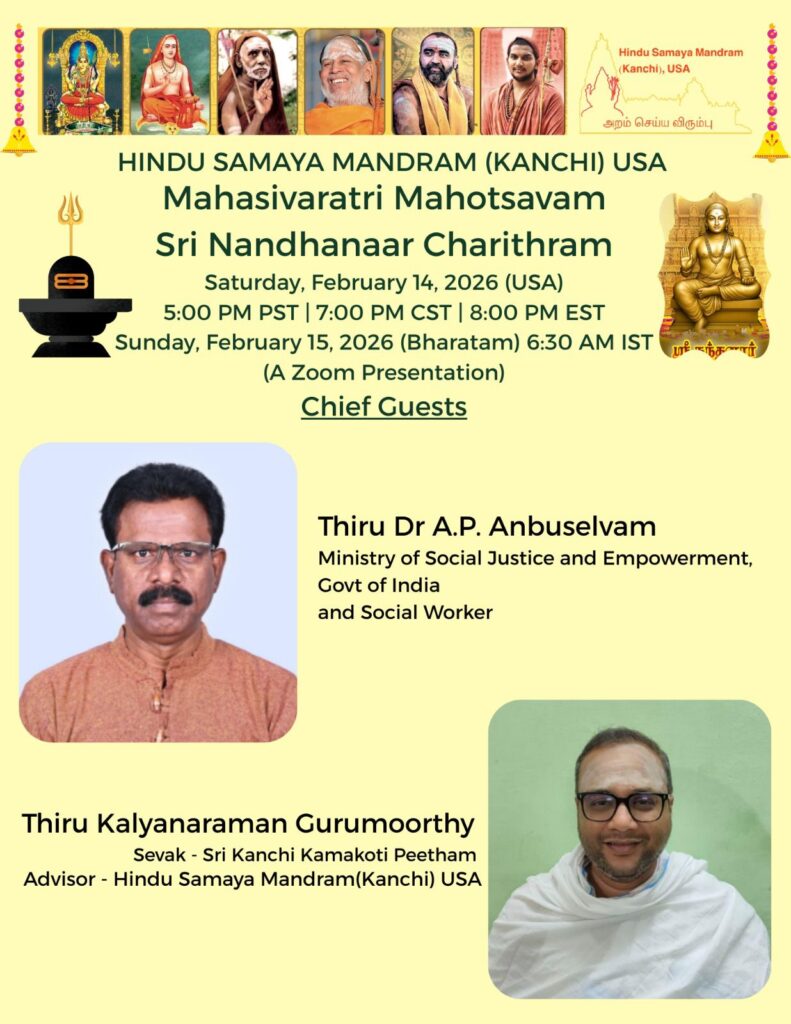
Join us with your family for the concluding day of our 7-day Mahasivaratri Mahotsavam.
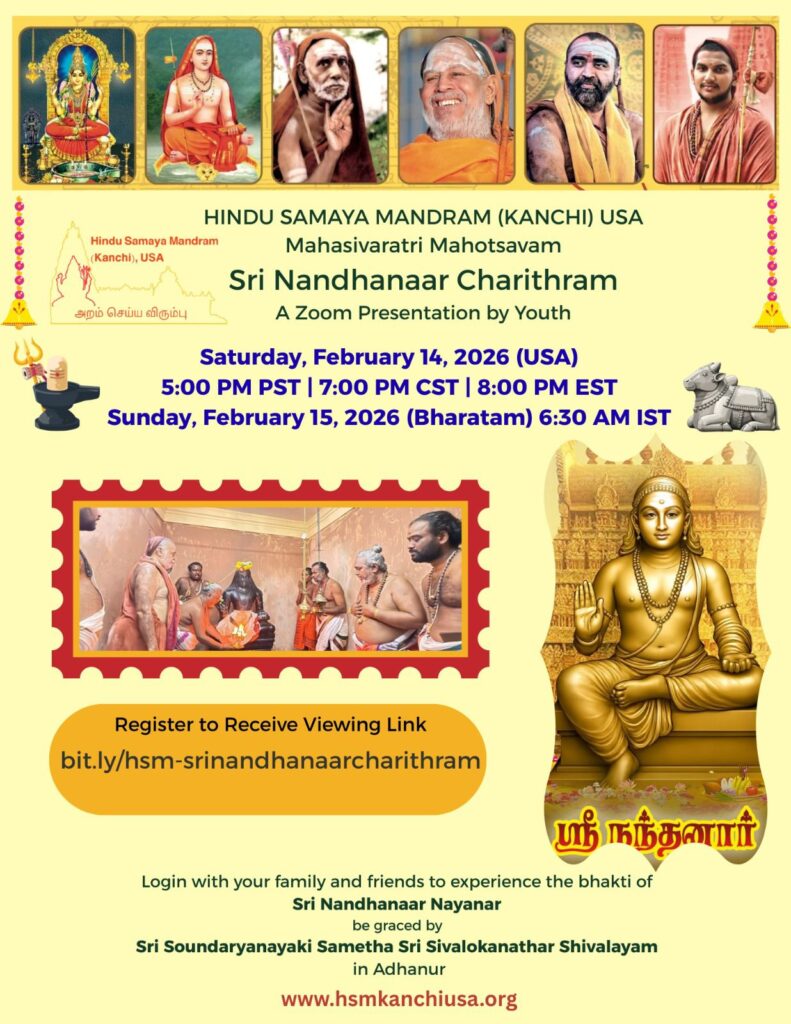
Saturday Feb 14th at 5 pm PST in the USA and on Feb 14th 3 pm GMT in the UK – for the conclusion of our 7-day Mahasivaratri Mahotsavam
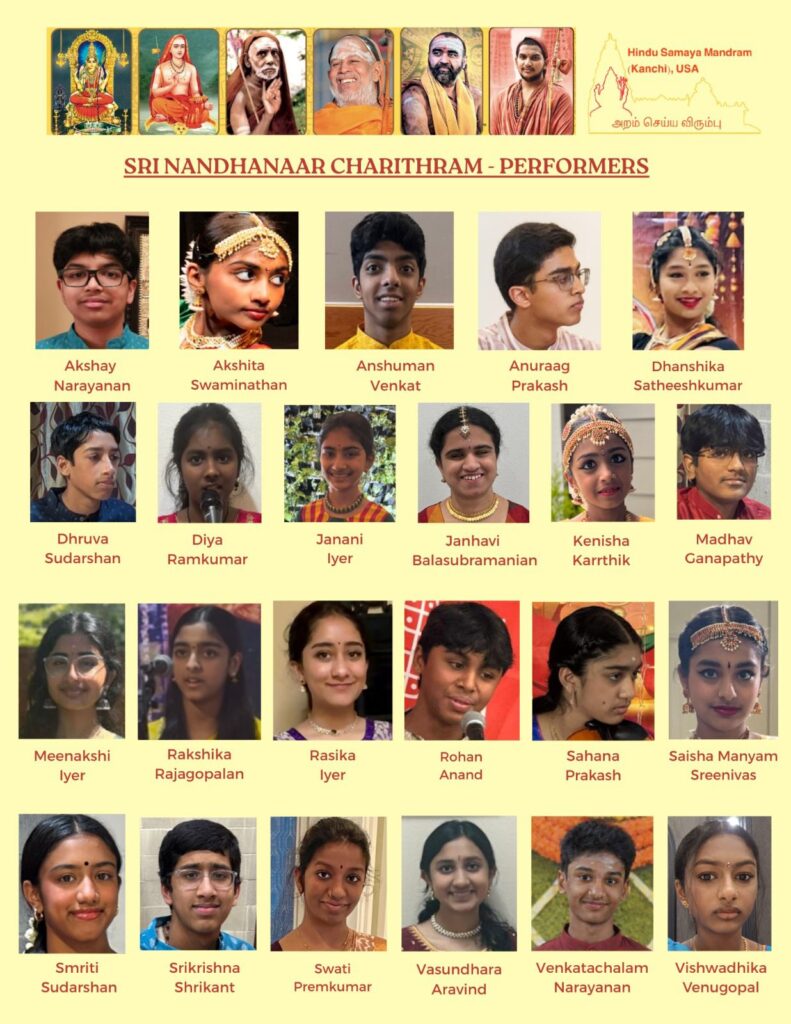
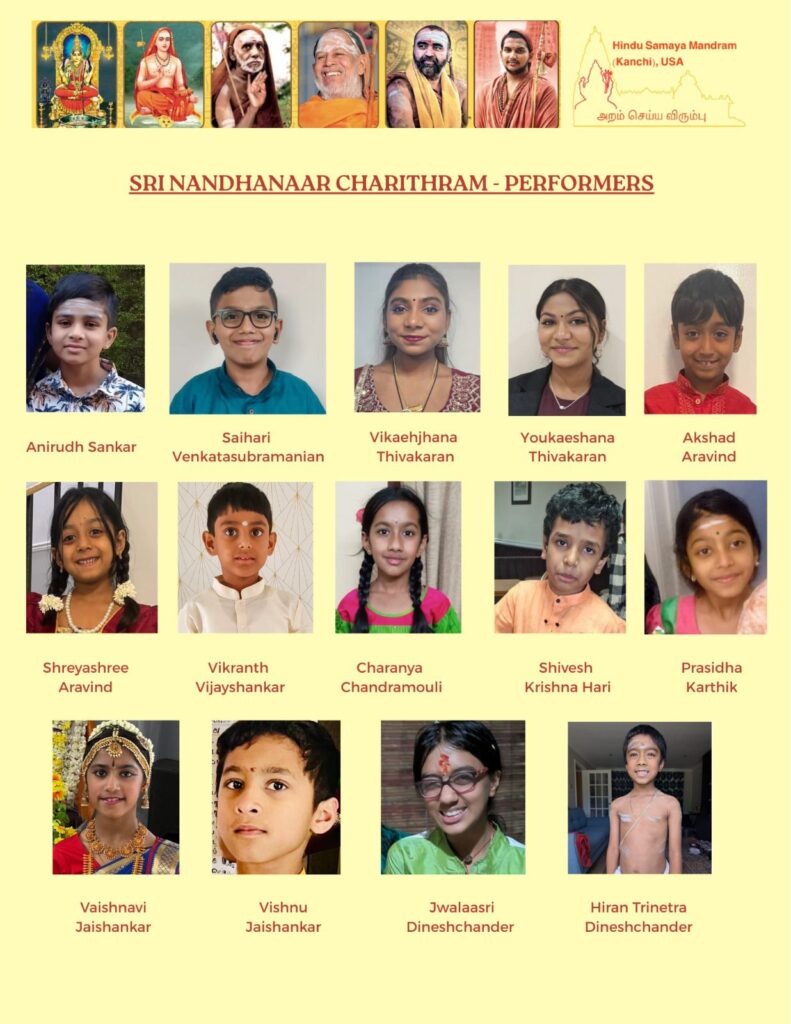
An online youth sangita presentation in English about the life and bhakti of Sri Nandhanaar Nayanar. This samarpanam is being offered by HSM youth in the UK and USA.
We will be joined by two special guests from Bharatam: Thiru Dr A.P. Anbuselvam, Ministry of Social Justice and Empowerment, Govt of India and Thiru Kalyanaraman Gurumoorthy, Sri Kanchi Kamakoti Peetham.
Can be viewed live on Kamakoti TV on Youtube – https://www.youtube.com/@kanchimath/streams